$36.95 $45.75
| /
NOTE: Z-Wave gateway controller required - sold separately.
We may have this product available in open box, refurbished, or used condition - just check the variant buttons under the product price for availability. All of our recycled inventory has been tested for both manual and Z-Wave control and is fully functional at the time of shipment. Here is what you can expect when ordering your device:
This product is available in different Z-Wave frequencies so please make sure you choose the correct region before checking out. You need to select the same frequency / region as your hub when buying Z-Wave devices for them to include to your system. If you're not sure which frequency your hub operates on, please contact your solution provider first. Here is what each option stands for:
Zooz Z-Wave Long Range 800 Series S2 Universal Relay Manual (PDF)
ZEN17 Frequently Asked Questions
Blog Post: How to Automate Your Yard with the Zooz Universal Relay
NOTE: If you don't see your Z-Wave controller on the list above, please contact us before you purchase this product.
Follow the appropriate diagram to wire the Universal Relay according to your application. If you don't see a diagram describing your set-up, please contact us to request help with the installation. Remember to always turn power off at the breaker before handling the wires. Never apply any voltage to the Sw input terminals!
Once you've completed the wiring, power the Universal Relay up with a USB C and a standard power adapter (sold separately) or a direct connection to 12 / 24 V power source.
Now add the Universal Relay to your hub: initiate inclusion (pairing mode) and click the Z-Wave button on the device 3 times quickly. The LED indicator will blink to indicate communication and stay on for 2 seconds to confirm inclusion.
You’ll most likely see 3 new on/off devices in your app:
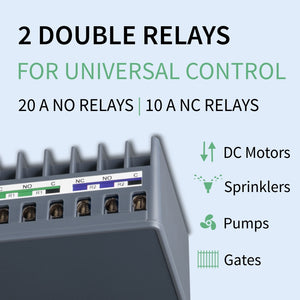
2 channels for on/off control of each relay
1 master node to control all relays at the same time and to access and adjust advanced settings in (if your hub supports parameter input)
Quick and easy installation. Easily connected to Home Assistant and works perfectly. I also like that you can update thee parameters to set power recovery options and manual switch functions.
I wired by garage door opener to the R1 on the zen17 and have a smartthings routine to open door when I arrive home. It works well and could not have done this without this relay.
Good, modern replacement for failed Insteon Relay that had been driving my garage door.
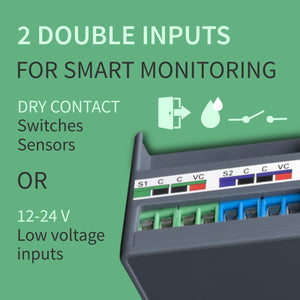
Overall, this device works well and is great option for garage door control. I have mine wired up where I am using the two output relays via the NO contacts to trigger my garage door opener and the light on the door opener. The two inputs are used to sense the status open/close of the garage door and a man-door at the rear of my garage using a couple of NC reed switches. I used smart-start to include this device in my network. There are many configuration options for this device and it took a while to fully read through and understand what each option needed to be set to.
I eventually configured everything as I needed for my scenario and everything seemed to be working perfectly. However, after a power outage (that I simulated) the two inputs would freeze with their last status. I would then try to re-interview the device, and the input entities completely disappeared. It would only recover after doing a complete exclusion and re-inclusion of the device. A factory reset didn't change this behavior. I found that if I used the manual inclusion method (not smart-start), regardless of if I chose to use Z-wave or Z-wave LR, that seemed to solve all my issues. I am running firmware 2.20. I can't say for sure if this is a problem with the device, Home Assistant, or my hub (I am using a ZST 39LR USB). Either way, the Zen17 seems to be working properly now as long as I include it in my network in that way. No significant complaints after my initial struggle.
On the hardware side of things, if I could make one improvement, it would be to move the screws for the terminals on the opposite side. Since I mounted my Zen17 to a wall, I had to remove it every time I wanted to make a change to the wiring. It was a bit of an inconvenience to have to wire everything before I mounted it to the wall.
Seriously, if you put a USB connector on a device, it should work properly with any normal USB cable plugged into it. If the device has specific power needs that require a specific charger that's not USB then *it should not use a USB jack*.
Frankly this is just unacceptable.
Assuming you power it correctly, it works pretty well :)