June 04, 2026
If you’ve ever tried shopping for smart switches, you already know how quickly things can spiral. What starts as “I just want a smart dimmer for my kitchen” somehow turns into reading about 3-way wiring, traveler wires, load ratings, relay switches, neutral wires, smart bulb mode, and whether your exhaust fan will explode if you accidentally install the wrong dimmer.
And honestly, we get it. Once you open up a switch box and start Googling terms like “single pole vs multi-way” or “line and load,” things can feel overwhelming fast. Instead of forcing you to compare every switch model and decipher electrical terminology on your own, our new guide walks you through the decision process step by step so you can narrow down the right switch for your setup without second guessing yourself.
Because the truth is, choosing the right switch really only comes down to a few key questions.
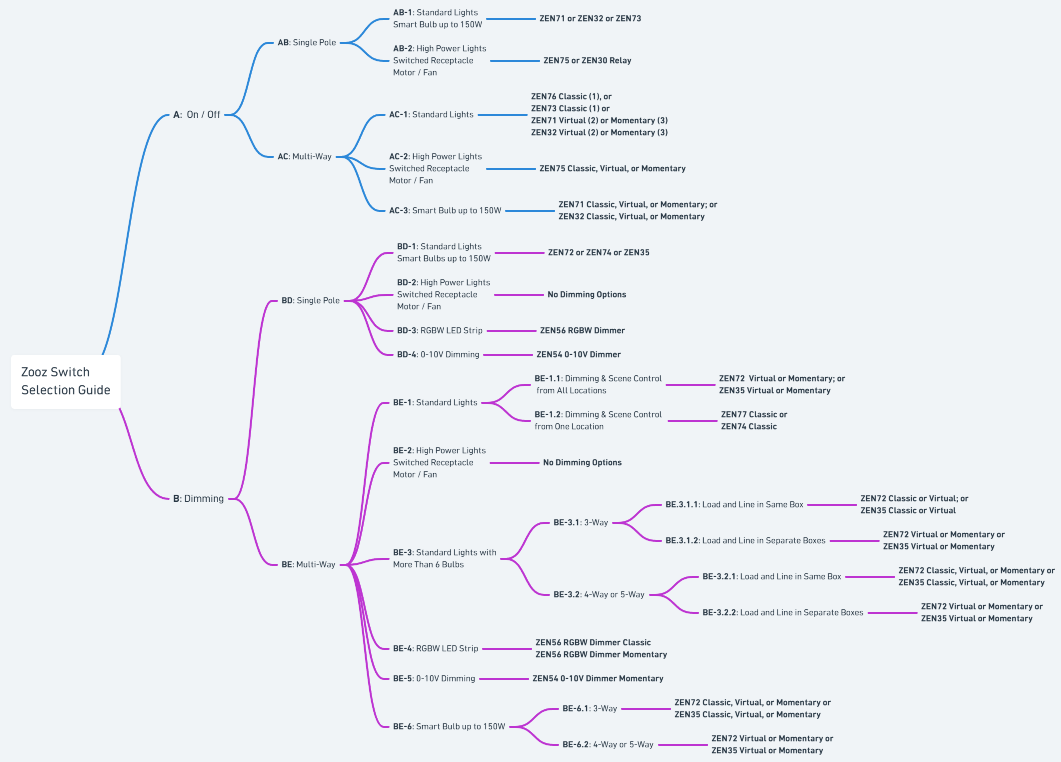
We've provided the flow chart for you here, along with a link to the guide created by Zooz for the specific recommendations and explanations for each section of the chart: The Smart Way to Choose a Smart Switch. You may want to zoom in or download the chart for a detailed view (there's a lot going on in there)!

This is the biggest fork in the road, and thankfully it’s usually the easiest one to answer. If you simply want to turn something fully on or fully off, you’re looking for a relay style switch. This is ideal for standard lighting, fans, switched outlets, and other loads that should always receive full power. If you want adjustable brightness levels, then you’ll want a dimmer instead.
While dimmers are great for standard lighting, not every load should be connected to one. Devices like ceiling fans, bathroom exhaust fans, motors, fluorescent fixtures with ballast, and switched receptacles should always use a relay style on/off switch instead. Using a dimmer in these setups can lead to flickering, buzzing, unreliable performance, or even damage to the dimmer itself over time.
For regular lighting, though, dimmers are often the preferred option. The ability to adjust brightness adds flexibility to a space and can completely change the feel of a room, whether you want bright task lighting in the kitchen or softer lighting in a bedroom or living area.
One of the first things you’ll need to figure out when choosing a smart switch is whether your lighting setup is single pole or multi-way. Thankfully, this part is usually easier than it sounds.
A single pole setup simply means one switch controls one light from one location. If you walk into a pantry, bathroom, or laundry room and there’s only one switch controlling that light, you’re almost certainly working with a single pole circuit.
Multi-way setups are a little more involved because they allow the same light to be controlled from multiple locations. Common examples are hallways, staircases, or large rooms with switches at different entrances. If you’ve ever turned a hallway light on downstairs and then turned it off from the second floor, that’s a multi-way circuit.
This is usually the point where smart switch guides start throwing wiring terminology and complicated diagrams at you, but in reality, the decision is often much simpler than it initially appears. At Zooz, we generally break multi-way installations into three main categories based on how much smart functionality you want and how much of your existing wiring setup you’d like to keep intact.
Classic installations are the most straightforward and are usually the easiest starting point for most homeowners. In this setup, you install one Zooz switch in the main box and keep the existing dumb switches in the secondary locations. It’s simple, cost effective, and works well if your main goal is adding smart control without completely rebuilding the circuit.
Virtual installations take things a step further by replacing multiple switches in the circuit with Zooz smart switches that communicate through your hub. These setups are popular for users who want scene control and/or dimming functionality from every switch location instead of just one.
Then there are Momentary setups, which use ZAC99 Momentary switches alongside the main Zooz switch or dimmer. These are especially useful in certain wiring situations and can be a great solution when you want additional control points without relying on traditional dumb switches.
The nice thing is that there really isn’t one universally “best” option here. The right choice depends entirely on your goals, your wiring, and how you actually use the space. Some people just want a simple smart upgrade that works reliably with minimal changes, while others want advanced scene control and automation access from every wall box in the house.
Once you’ve narrowed down your wiring setup and the type of load you’re controlling, the switch selection itself usually becomes much more straightforward. For most homes, the decision comes down to balancing installation simplicity, switch style, and how much smart functionality you want at the wall.
For standard on/off lighting, the ZEN71 On/Off Switch is still one of the most flexible options in the lineup. It works well in both single pole and multi-way installations and is especially popular in Virtual and Smart Bulb Mode setups where you want more advanced smart control throughout the circuit. For dimming, the ZEN72 Dimmer has all the same benefits and applications as it's ZEN71 counterpart, with the addition of dimming functionality.
That said, for traditional multi-way wiring with existing dumb switches, the ZEN76 On/Off Switch has become one of the most popular choices for a reason. Along with its toggle counterpart, the ZEN73 Toggle Switch, it uses Zooz’s patented multi-way design that dramatically simplifies installation in many 3-way and 4-way setups. Instead of requiring rewiring in the secondary box like many smart switches on the market, these models are designed to work with the existing dumb switches already in place, making upgrades much faster and far less intimidating for homeowners and installers alike.
For dimming applications, the same idea applies. The ZEN77 Dimmer and ZEN74 Toggle Dimmer use that same patented multi-way approach, allowing dimming upgrades in many multi-way circuits without needing to rework the wiring in the other switch boxes. For a lot of users, that simplicity ends up being the deciding factor because it turns what could have been a complicated rewiring project into a much more approachable switch replacement.
If you prefer a more advanced smart home experience with scene control and automation triggers directly from the wall, the ZEN32 Scene Controller and ZEN35 Scene Dimmer add programmable buttons alongside standard lighting control. These are especially popular in larger smart home setups where a single switch might also trigger routines, scenes, or other devices throughout the house.
For heavy lighting loads or non-lighting loads like switched receptacles, fans, or motors, the ZEN75 Heavy Duty Switch is the clear choice every time.
The nice thing about the lineup overall is that it isn’t really built around a single “best” switch. Some models are designed to make traditional multi-way upgrades as painless as possible, while others focus more heavily on scene control, advanced automation access, or flexible smart bulb integrations. The right choice really depends on how you want the space to function once the installation is complete.
Smart bulbs tend to change the conversation quite a bit because they operate differently from standard lighting. With regular bulbs, the wall switch physically controls power to the fixture. Smart bulbs, on the other hand, need constant power in order to stay connected to your smart home network. If power gets cut at the switch, the bulbs essentially go offline until power is restored again, which is why smart bulb setups need to be handled differently from traditional lighting.
All Zooz switches support Smart Bulb Mode, which allows the switch to keep constant power flowing to the bulbs while still letting the switch itself trigger scenes, automations, and smart commands through your hub. In practice, this gives you the convenience of wall control without constantly disconnecting the smart bulbs from the network.
Technically, any Zooz switch can be used with smart bulbs in a single pole installation when Smart Bulb Mode is enabled. Multi-way installations are where compatibility becomes much more important, though. The ZEN76, ZEN77, ZEN73, and ZEN74 series cannot be used with smart bulbs in multi-way configurations, even though they work extremely well for standard lighting loads in traditional multi-way wiring.
For multi-way smart bulb setups, Virtual installations are usually the best overall experience because every switch location remains smart, programmable, and fully synchronized through the hub.
It’s also important to set realistic expectations when it comes to dimming smart bulbs from a wall switch. In general, we don’t recommend trying to directly dim smart bulbs using a smart dimmer because the experience usually isn’t as smooth or responsive as dimming standard bulbs electrically. Instead of the dimmer controlling brightness directly at the circuit level, the command has to travel from the switch to the hub and then from the hub to the smart bulb, often across different wireless protocols. That extra communication layer can introduce delays and make dimming feel less natural than people expect. In most cases, we’ve found that smart bulb setups work best when the switch is used to trigger scenes, presets, or automations instead of acting like a traditional dimmer. For example, a button press could activate a movie scene, nighttime lighting preset, or favorite brightness level instantly without relying on constant real-time dimming adjustments.
While most people are shopping for standard switches and dimmers, there are also lighting projects that need more specialized control solutions.
RGBW LED strips are a good example because they require dedicated low voltage color control rather than traditional phase dimming. That’s where the ZEN56 RGBW Dimmer comes in. It’s specifically designed for color changing LED strip lighting and gives you much more precise control over brightness and color channels.
Similarly, 0-10V lighting systems use an entirely different dimming method that’s commonly found in commercial spaces and certain high efficiency fixtures. The ZEN54 0-10V Dimmer was designed specifically for those applications and works with compatible 0-10V drivers and systems.
These are the kinds of setups where using the correct hardware really matters, because trying to force a standard wall dimmer into a specialized lighting application usually creates more frustration than results.
One of the biggest misconceptions about smart switches is that choosing one should be as simple as picking a style you like and installing it in the wall. In reality, the switch itself is only one piece of the puzzle. The type of load you’re controlling, the wiring already in the wall, the number of bulbs on the circuit, whether you’re using smart bulbs, and even how many locations control the light all play a major role in determining which setup will actually work best.
After years of helping customers troubleshoot installations, compare models, and untangle confusing wiring situations, we realized the biggest challenge usually wasn’t the installation itself. It was figuring out where to even start. Most people were trying to work backwards from product names and spec sheets instead of starting with the actual requirements of the circuit.
The Zooz Switch Selection Guide was built to simplify that process.
Instead of forcing you to sort through every switch, dimmer, wiring diagram, and compatibility note all at once, the guide walks through the decision making process step by step so you can narrow things down logically based on your specific setup. Whether you’re upgrading a simple single pole light switch, tackling a multi-way dimmer installation, adding smart bulb control, or planning a larger smart lighting project across the house, the goal is the same: helping you choose the right device the first time, with a lot less frustration along the way.
Because once you understand how your setup actually works, choosing the right smart switch suddenly becomes much less overwhelming.
December 26, 2025
If you love a good DIY project and a touch of smart home magic, you’ll be blown away by what YouTuber DIY With Vinny pulled off. His YouTube tutorial transforms a simple closet into a fully automated, jaw-droppingly smart space, from leak detection to mood lighting and robot-friendly automation.
The best part? It’s powered by some seriously smart Zooz Z-Wave gear that makes everything run seamlessly behind the scenes. All of the Zooz devices featured here support the new Z-Wave Long Range protocol, so your smart home stays connected and responsive, even across floors, garages, or detached spaces.
Let’s take a tour of this build and peek at how you can recreate it in your own home.
August 11, 2025 5 Comments

Smart home tech isn’t just for indoors anymore—it’s transforming yard care too. While we’re used to voice assistants and smart thermostats, outdoor tools like sprinkler systems are catching up. Instead of wasting water on rigid schedules, smart systems adapt to the weather, skip rainy days, and keep your lawn healthy with minimal effort.
Smart sprinkler control makes it easy to upgrade your existing irrigation system with a device like the Zooz ZEN17 Universal Relay. Compatible with SmartThings, Hubitat, Z-Box, Home Assistant, and HomeSeer, it fits into most smart home setups without locking you into one platform. This post covers the benefits of automating your sprinklers, how to set up the ZEN17, control options, and real user tips to help you get the most from your system.
June 12, 2025 2 Comments
Imagine this: it’s a stuffy summer night, and you’re already in bed when you realize the ceiling fan is off. Or maybe you’ve left the house and can’t remember if the bathroom fan is still running. What if your fan could turn on automatically when the room gets too warm—or shut off when no one’s around?
That’s the beauty of smart fan control. It’s not just about convenience (though turning your fan on with your voice or a tap on a smart remote is pretty great). It’s about making your home more energy-efficient, more responsive, and just... smarter.